The operating system for water networks
Run the water network.
As one system.
Understand what changed. Decide where to act. Coordinate operators, AI agents, and field teams from the first signal to service recovery.
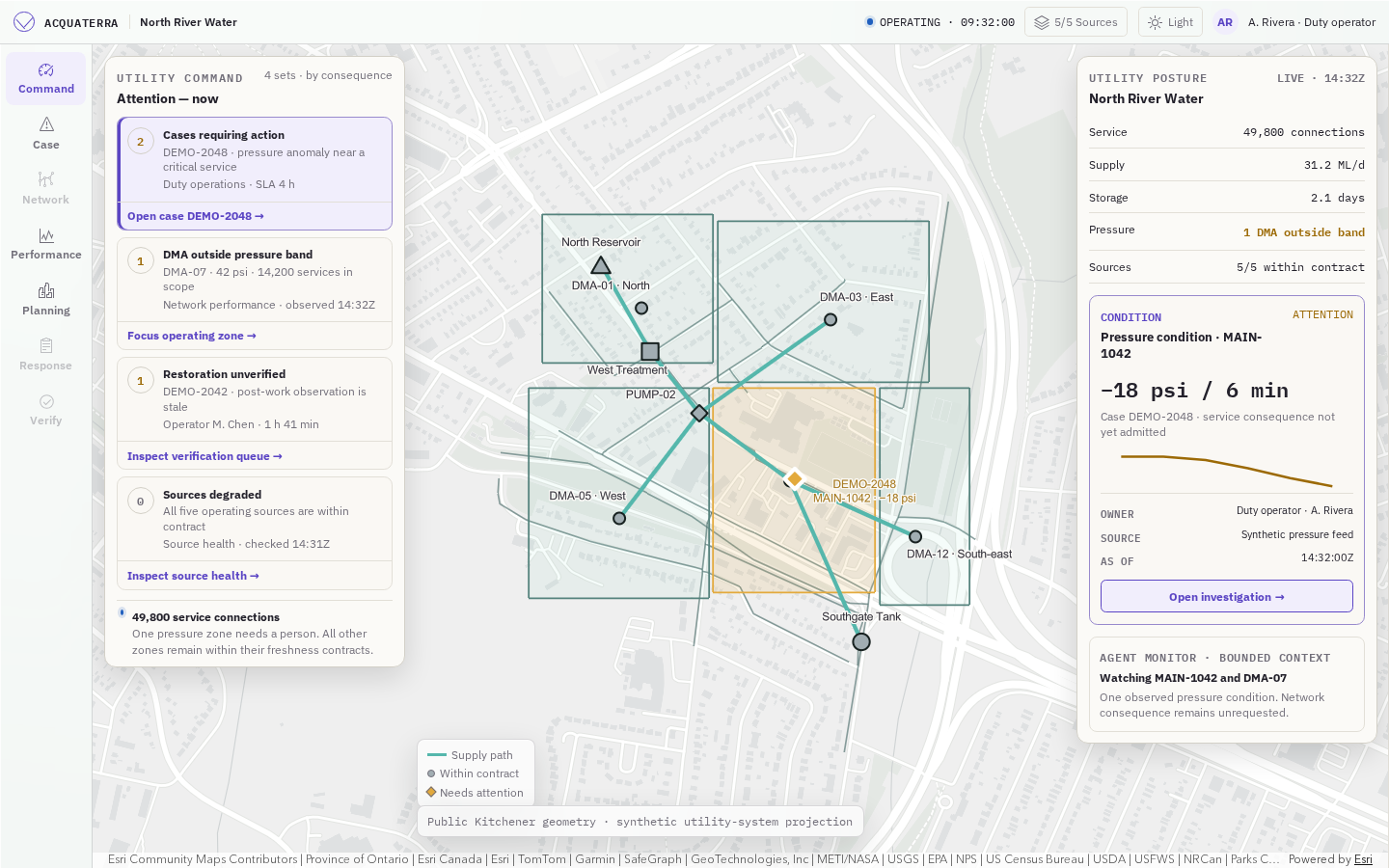
Pressure falls.
What happens next?
Observed drop
in six minutes
The observation opens an investigation.
It does not establish a cause.
One system · Four horizons
Run today.
Shape what comes next.
Anticipate failures. Prioritize the work. Investigate incidents, review water balance, and prioritize maintenance and renewal by failure risk, cost, and service impact.
Understand your water balance.
Review water balance and service patterns in their network context. Separate measured inputs from derived residuals before choosing an intervention.
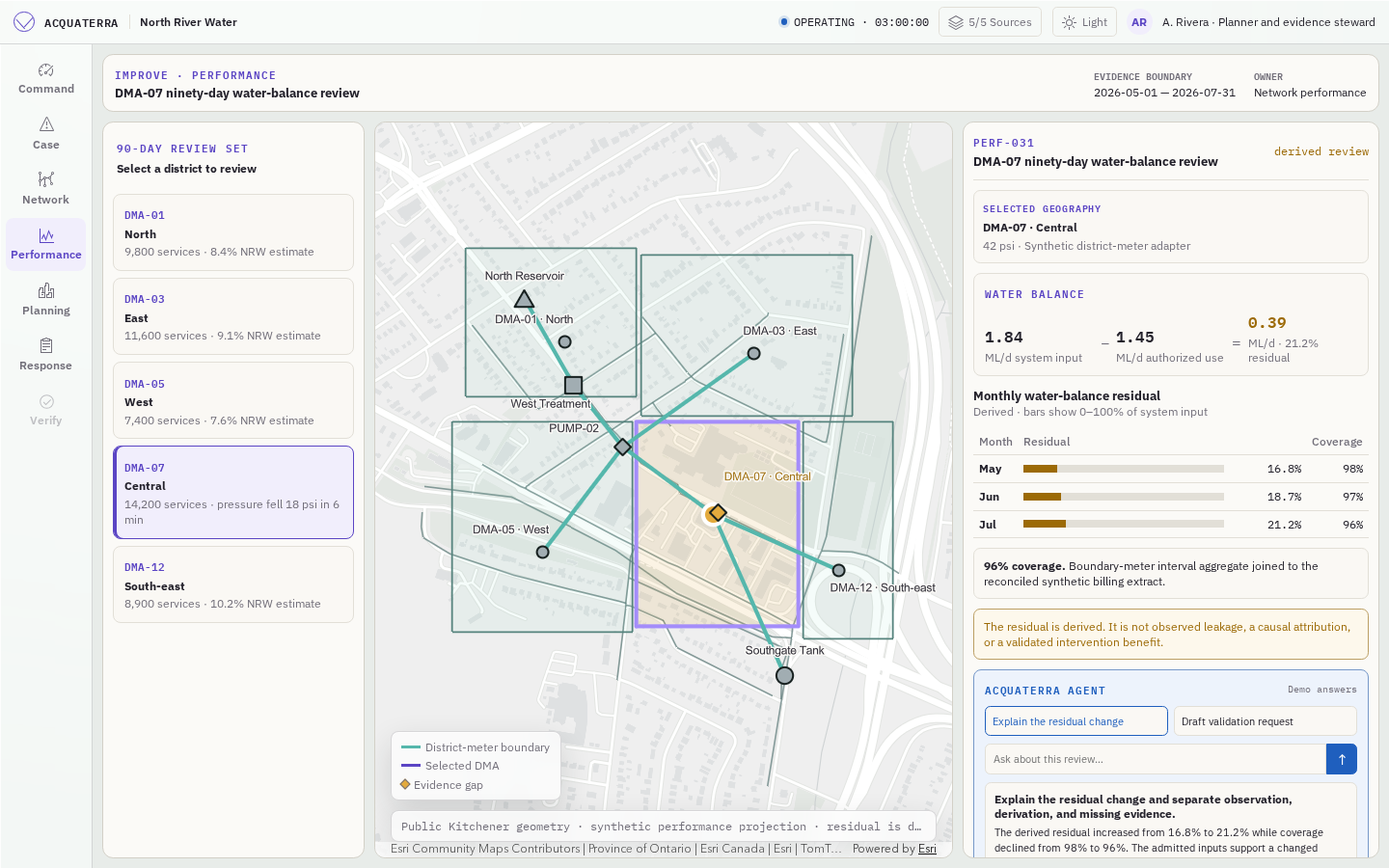
Observed inputs and a derived residual remain visibly distinct.
Actual application · synthetic demonstration · public network geometry
From geography to understanding
The network has context.
Put it to work.
Connect assets, sensors, work history, and service relationships in one operating graph. Operators and AI agents use that shared context to investigate conditions, compare options, and prepare work for review.
See what connects.
↗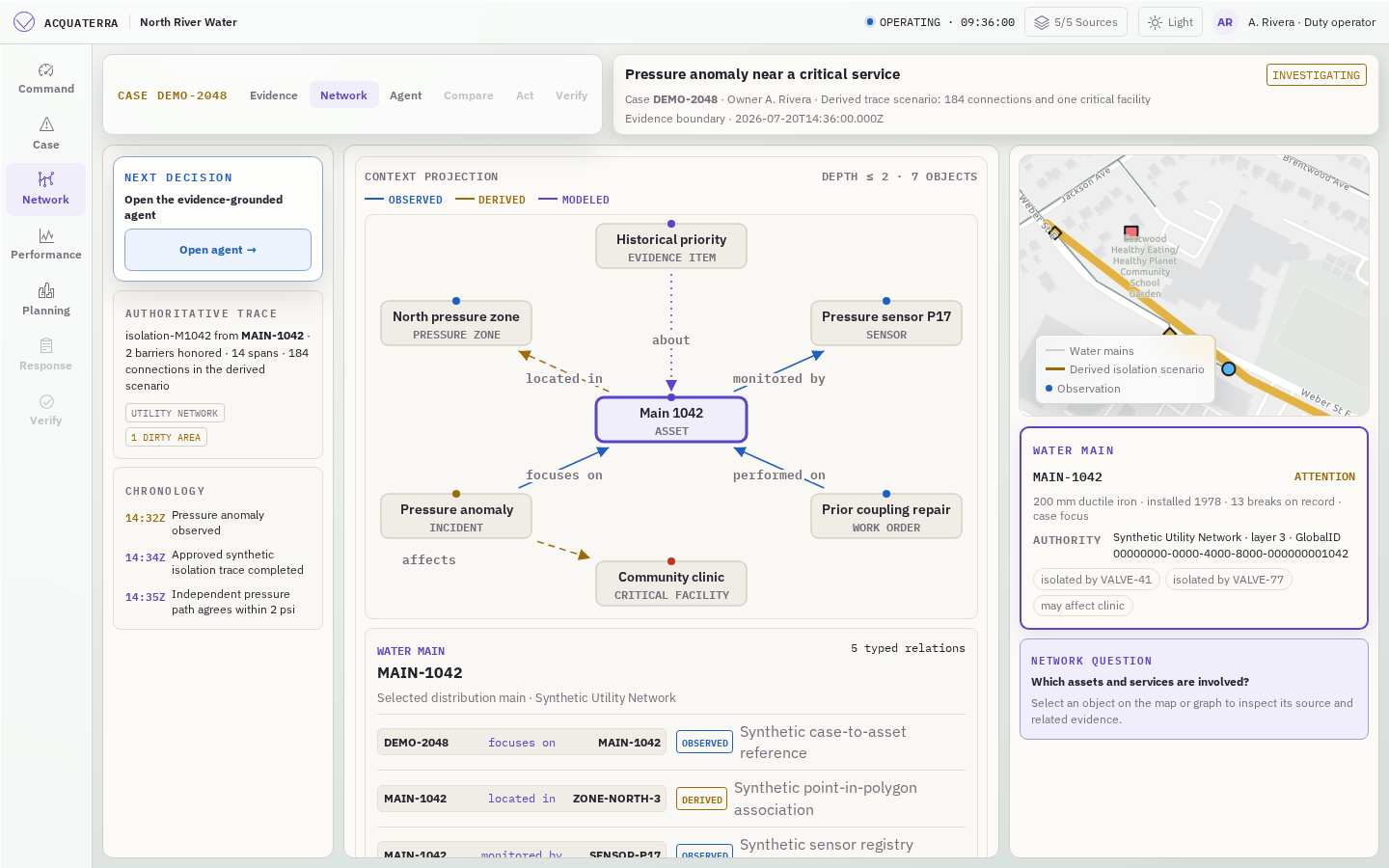
Relationships from the demonstration
- Main → monitored byPressure sensor P17Observed
- Main → located inNorth pressure zoneDerived
- Repair → performed on → mainPrior coupling repairObserved
- Priority → about → mainHistorical priorityModeled
- Anomaly → focuses on → mainPressure anomalyObservedAnomaly → affects · DerivedCommunity clinicPotential impact, not confirmed interruption
Follow the evidence from the asset to the people and services that may depend on it.
Potential impact remains distinct from a confirmed interruption.Investigate. Keep the result.
↗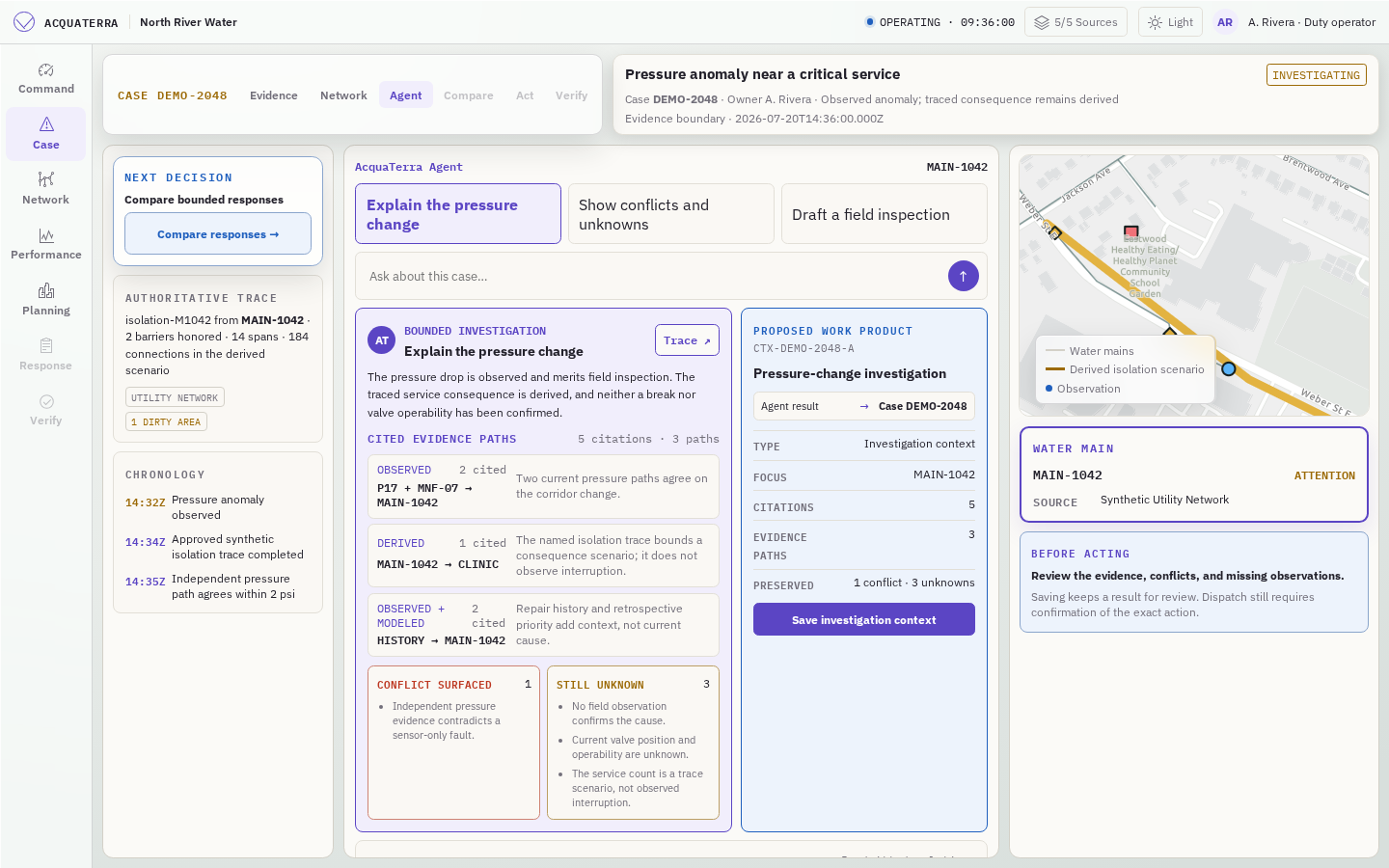
Inspect the saved investigation
The evidence stays with the work.
Agents assemble evidence, compare explanations, and prepare work for review. Sources and open questions stay with the investigation.
Saving the investigation does not authorize field work.Synthetic demonstration. Application captures with a portrait relationship guide on phones. Explore the full states in the product tour.
Close the operating loop
The job is done.
Is the service restored?
Carry the decision into the field. Bring the evidence back. Check whether the service—not just the work order—has recovered.
- 01 / INVESTIGATE
Prepare the response
Evidence and unknowns travel with the recommended work.
PROPOSED - 02 / AUTHORIZE
Approve the work
A person reviews the exact asset, scope, and consequence.
HUMAN CONFIRMATION - 03 / EXECUTE
Record field work
The observation and work performed return against the task.
WORK EVIDENCE - 04 / EVALUATE
Verify service recovery
Independent observation informs the supervisor’s outcome decision.
SERVICE EVIDENCE
Bring the result into the next decision. Field evidence and service outcomes return to the operating graph to evaluate predictions and refine maintenance priorities.
Inside AcquaTerra
From the first signal
to the service outcome.
Follow the same main through the actual application. The map, relationships, agent investigation, and field work stay connected to the decision.
Explore the six-step product walkthrough
MAIN-1042 / 01
Start with the signal.
A pressure drop opens an investigation around MAIN-1042. The operator sees the observation, its source, and what needs to happen next.
18 psi in six minutes. Cause and service impact are not yet confirmed.
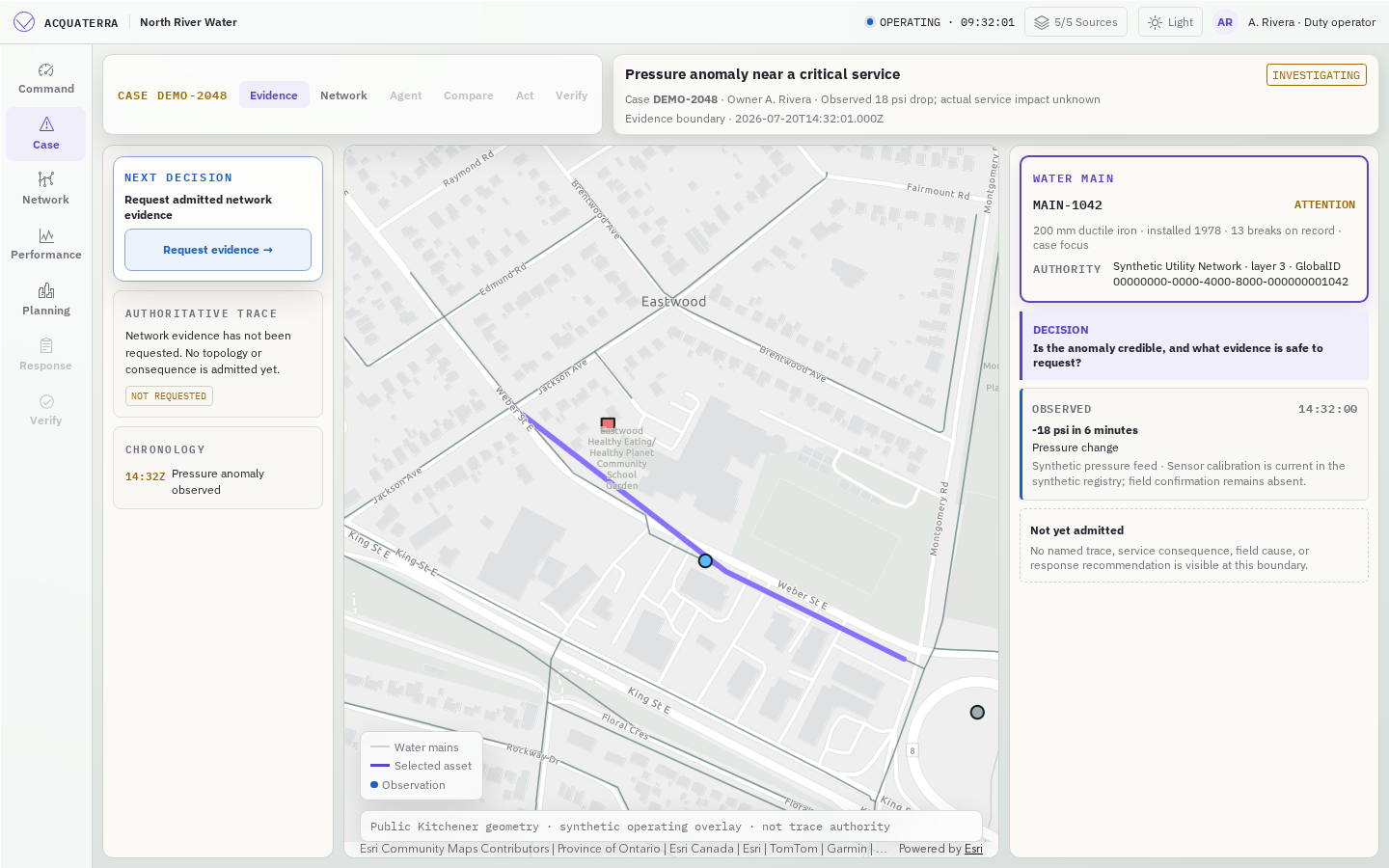
Read the observed change before inferring a cause.
Guided product tour · public Kitchener geometry, synthetic operating facts. Selecting a step explores captured app states; it does not execute work.
Built around your utility
Connect the systems.
Keep control.
Your network records, telemetry, models, and work systems have different jobs. AcquaTerra brings their evidence into the same decision—and sends approved work back through the system that owns it.
Discuss your operating environmentKeep every fact attributable.
Network records, telemetry, models, work, and field evidence retain their source identity and time. Observations, derived results, estimates, and proposed actions remain distinguishable in the operating context.
Put predictions in operating context.
Spatiotemporal graph neural networks support failure-probability estimates; compare them with intervention costs and service consequences to prioritize maintenance. Predictions remain distinct from observations. Field outcomes support model evaluation and reviewed updates.
Keep consequential action explicit.
An agent’s answer is not permission to act. Review the exact asset, scope, consequence, and revision before confirmation. Changed proposals require new confirmation; uncertain submission results require reconciliation.
Keep the utility in control.
Set access, hosting, audit, recovery, and export requirements around your operation. Acceptance includes the ability to operate, change, restore, and export the delivered system.
From operating priority to deployment
Start with your
operating priority.
Pressure anomalies. Recurring water loss. Asset renewal. Choose the decision that matters, connect the evidence, and define the result your team needs.
- 01
Define the outcome.
Choose the network area, decision, and responsible team. Agree how the result will be evaluated.
- 02
Connect your systems.
Align assets, observations, work records, and permissions across the systems you already operate.
- 03
Validate in operation.
Follow the case from investigation through field work and service verification. Use the results to guide expansion.
AcquaTerra / by SpatioTerra
Your network.
One operating system.
See how your team can investigate, decide, and act in one system.